




Contact our friendly team for more information on our full range of buildings and how to start the process of hiring or buying a modular building for your business. Our expert team is always available to give advice, guidance or support.
Published: 21 August 2026 in Sectors
One in Five: What England’s Rising SEND Numbers Mean for School Building Plans
If you’re responsible for school places in your area, you’ve probably felt this before you saw it in any report. SEND referrals are climbing, waiting lists are getting longer, and the mainstream classroom that used to flex a little no longer does. In June 2026, the Department for Education put a number on what a lot of local authorities and trusts already knew from experience: more than one in five pupils in England now has an identified special educational need.
We build SEND classrooms for a living, so a statistic like that reads to us as a building schedule and not just a policy headline.
The numbers, in plain terms
The DfE’s Special educational needs in England release, published 11 June 2026, put the figure at 1,858,327 pupils, or 20.8% of every pupil in a state-funded school. That’s 91,400 more children than the year before, a 5.2% jump in twelve months.
The growth isn’t evenly spread. It’s steepest at the sharp end. 538,547 pupils now hold an Education, Health and Care (EHC) plan, up 11.6% year-on-year and more than double the number in 2016. Another 1,319,780 pupils are on SEN Support, meaning their needs are met within a mainstream school’s own resources without a formal plan, up a further 2.8%.
Autism is the most common need behind an EHC plan (33.5%), followed by speech, language and communication needs (22.1%). For pupils on SEN Support, speech and language needs top the list at 25.7%, with social, emotional and mental health needs close behind at 24.8%. This is a system serving more children, with more complex needs, than it was five years ago.
Why the paperwork is backing up too
The assessment process is under the same pressure as school rolls. The DfE’s Education, health and care plans: England 2026 release, published 25 June 2026, recorded 718,838 EHC plans in place nationally as of January 2026, up 12.5% on the year. Local authorities issued 110,708 new plans in 2025, up 13.3%, against 162,702 requests for assessment, up 5.3%.
EHC plans carry a statutory 20-week deadline. In 2025, only 46.1% were issued in time, down slightly from 46.4% the year before. Fewer than half of new plans met the timescale the law sets, and last year was worse than the one before it.
The money is moving
Government has finally attached a hard number to the fix. In its 23 February 2026 announcement, Specialist SEND support in every school and community, the DfE confirmed a £4 billion SEND reform package. £3.7 billion of that is capital funding for 60,000 new SEND places, with around 10,000 already delivered, leaving roughly 50,000 still to build. Alongside it sits £1.6 billion over three years for an Inclusive Mainstream Fund, and £1.8 billion over three years for specialist professional support through an “Experts at Hand” service.
Education Secretary Bridget Phillipson put it plainly: “Children with SEND deserve a system that lifts them up, and puts no limit on what they can achieve.” Turning that into 50,000 real, compliant classrooms is an estates and construction problem as much as a funding one. It’s landing on councils and trusts whose basic need capital budgets were already stretched before this money arrived.
What this means if you’re planning a build
A few things follow, whichever seat you’re sitting in.
Your estates plan is probably behind the curve already. An 11.6% year-on-year rise in EHC plans will outrun most five-year projections drawn up even eighteen months ago. It’s worth checking your numbers against this year’s trajectory rather than last year’s.
The funding window is real, but it’s tight. With around 50,000 places still to deliver, capital has to turn into usable classroom space inside a single academic cycle. A traditional build usually takes two to three years.
Compliance requirements don’t disappear because the timeline is short. Every new SEND space has to meet Part M of the Building Regulations for accessibility, plus BB104, the DfE’s own design guidance for SEND and alternative provision. That covers acoustic control, sensory environments, and hygiene suites with hoists and adjustable equipment. Speed only counts if what you build still meets the standard.
Where Springfield fits in
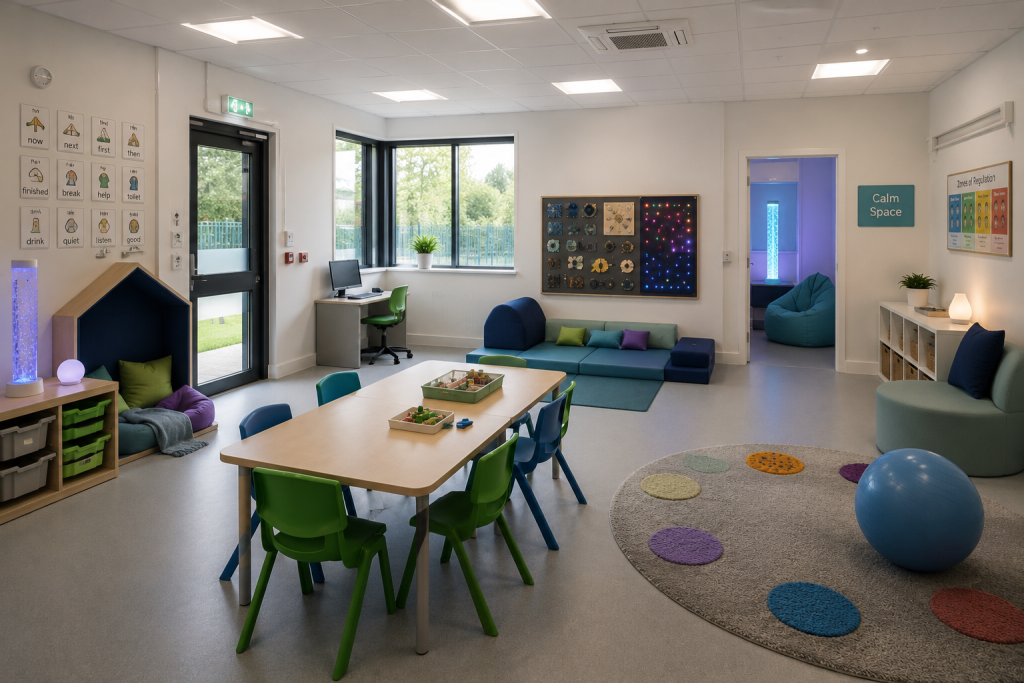
Our SEND Classrooms are designed to BB104 and Part M standards from the first drawing. Sensory rooms, therapy spaces, acoustic control, and hygiene suites are part of the original spec, so they don’t need to be added later. Custom builds are typically ready in around six weeks. Stock units can be on site within days. Every project comes with a dedicated project manager who handles planning permissions, building control, and installation, so a capital allocation can become a finished classroom inside one budget cycle.
If you’re working to a high needs capital deadline, or trying to close a SEND places gap before next September, we’d like to talk. Get in touch with the Springfield team about what a fast, fully compliant SEND building programme could look like for your schools.
Sources:
- Department for Education, Special educational needs in England: January 2026, published 11 June 2026
- Department for Education, Education, health and care plans: England 2026, published 25 June 2026
- Department for Education, Specialist SEND support in every school and community, published 23 February 2026


